Charlotte Personal Injury Attorney Matthew R. Arnold of Arnold & Smith, PLLC answers the question “What exactly is a wrongful death claim?”
It was a case that experts on both sides of the legal spectrum have been anxiously awaiting and it ended in a victory, of sorts, for General Motors. The automaker just concluded the first of likely hundreds of lawsuits involving a faulty ignition switch that the company was aware of for years yet did nothing to fix until details emerged publicly recently. Many expected the first case, one of several bellwether cases that were hand picked by plaintiffs, to end differently. Though it’s good news for GM, at least for now, experts say the car company shouldn’t be so quick to breathe a sigh of relief.
Charlotte Personal Injury Attorney Matthew R. Arnold of Arnold & Smith, PLLC answers the question “What can you sue for in a personal injury case?”
Everyone knows about the dangers associated with distracted driving. Commercials and public service announcements routinely warn drivers of the importance of focusing on the road in front of you and not on other distractions, usually cellphones. A subset of distracted driving that seldom gets the attention it deserves involves tired drivers. Drivers who are exhausted are just as if not more dangerous than those busy texting. Thankfully, a new push by federal lawmakers appears designed to bring increased attention. To find out more, keep reading.
Charlotte Personal Injury Attorney Matthew R. Arnold of Arnold & Smith, PLLC answers the question “What exactly is a wrongful death claim?”
Damage caps in personal injury cases have become an increasingly hot topic in recent years, with courts across the country wrestling with the issue. State high courts have been left to decide whether and when such caps, usually on noneconomic damages or medical malpractice payouts, are appropriate or even constitutional. Some, such as Florida, have decided that such caps are not only unconstitutional, but also completely ineffective. Others, like the recent case in Tennessee, have looked for ways to avoid making such a decision. To find out more about the recent case, keep reading.
Charlotte Personal Injury Attorney Matthew R. Arnold of Arnold & Smith, PLLC answers the question “Can I wait a few months to pursue a personal injury claim?”
Were you, or someone you know, in an accident that involved an Uber driver over Halloween? Ride sharing companies such as Uber and Lyft are extremely popular on holidays like Halloween and New Year’s Eve. These companies offer an effective and safe way to get home after a fun night out with friends. But what happens if you are in an accident while utilizing one of these ride-sharing services? What happens if you are in an accident while driving your own vehicle, but the accident is the fault of the Uber driver? Does it matter if the Uber driver is driving her car for personal or business reasons? These issues have been rapidly evolving in the insurance/legal world, but are still largely unknown to the general public.
Charlotte Personal Injury Attorney Matthew R. Arnold of Arnold & Smith, PLLC answers the question “What is partial versus total disability, and temporary versus permanent disability?”
The dangers of distracted driving are well known at this point. Commercials and public safety ads have repeated over and over how much texting can increase a person’s risk of being involved in a deadly car accident. Despite the apparent danger, millions of people continue to text behind the wheel every day, with alarming percentages of motorists admitting to reading and responding to text messages while driving.
Charlotte Personal Injury Lawyer Matt Arnold answers the question “What if the accident was my fault?”
Lawyers representing the victims of a fatal crash on I-85 near Chapel Hill have added two businesses as named defendants to their lawsuit. The crash occurred when a 20-year-old UNC student, Chandler Kania, collided head on with a vehicle on I-85 while traveling in the wrong direction on the interstate. The crash occurred at 3:00 a.m., killing three and leaving a nine-year-old girl as the only survivor in the victims’ car.
Charlotte Personal Injury Attorney Matthew R. Arnold of Arnold & Smith, PLLC answers the question “What if a loved one dies from the injuries sustained in a serious accident while the case is pending?”
If you have imbibed, over the holidays, a little too much of the alcohol-spiked eggnog, you should think twice before handing the keys over to your teenage child or relative to run out for supplies or snacks.
One Pennsylvania father has learned that the hard way.
Michael Ware initially told investigators that his 15-year-old daughter had taken his Sports-Utility Vehicle out for a drive without his permission. Authorities later learned, however, that Mr. Ware allowed his daughter—who did not have a driver’s license at the time—to drive his 2001 Chevrolet Suburban to a nearby barbecue restaurant.
Ware even walked his daughter and her three friends out to the car and asked them to bring him back a sandwich as they pulled away. A short time later, the daughter wrecked the Suburban, killing friends Cullen Keffer, Shamus Digney and Ryan Lesher. All three boys were just fifteen-years-old.
A witness to the accident said she could hear the boys crying out for the daughter to slow down before speeding around a sharp curve. The vehicle flipped, ejecting two boys from the vehicle and pinning a third beneath it. One of the boys passed away on the scene; two more passed away at a nearby hospital.
Charlotte Personal Injury Attorney Matthew R. Arnold of Arnold & Smith, PLLC answers the question “What if the accident was my fault?”
A 17-year-old girl who was “virtually decapitated” at the waist when she “jackknifed” over the lap belt in a 1996 Toyota 4Runner has been awarded $12.5 million by a California jury. If she had brought suit in North Carolina, her case would have been dismissed.
Toyota spokeswoman Carly Shaffner said the carmaker respected the jury’s time and consideration, but she remained confident that plaintiff Chelsie Hill’s injuries “were not the result of a defect in the 1996 Toyota 4Runner.” The jury reached the opposite conclusion after four hours of deliberations.
Hill—now 22—was a passenger in the February 21, 2010 crash in Monterey, California. Driver Aaron Corn, who was only 18 at the time and was driving while under the influence of alcohol, struck a tree while driving 30 miles per hour. The jury found that Corn was five-percent responsible for Hill’s injuries and that Hill was five-percent at fault for getting into a car with a drunken driver.
Dr. Robert Lieberson, the neurosurgeon who treated Hill after the crash, said the lap belt severed the girl at her midsection, and she was only held together by her skin. Lieberson and others testified that Hill used the belt properly.
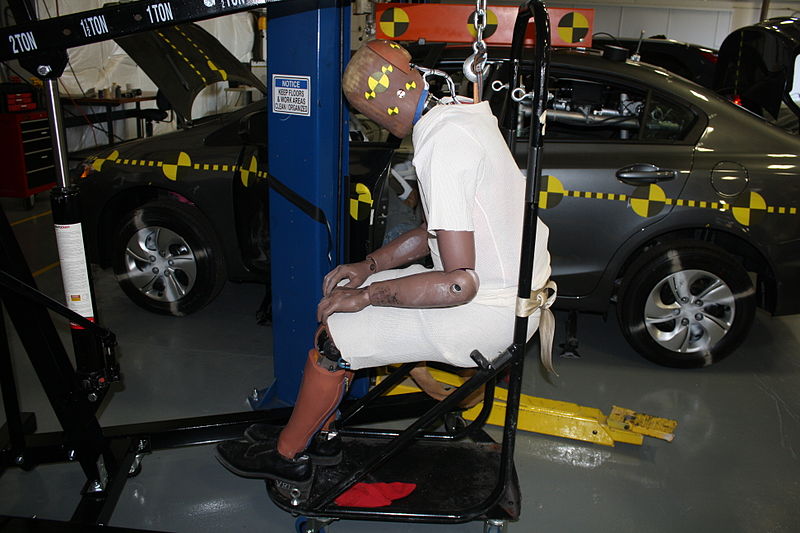
Hill’s attorney suggested that Toyota chose to install the least safe and least expensive restraint system in the seat. Videos shown to the jury depicting dummies compared crashes involving lap belts against those with shoulder belts. Test dummies with lap-only belts jackknifed violently in crashes, while dummies in lap-and-shoulder belts remained upright.
Attorney Matthew R. Arnold answering the question: “Should I trust the insurance adjuster?”
Though we have all heard about the dangers of texting while driving, many may not realize that other activities, such as mapping while driving, can be just as deadly. The Department of Transportation has decided to publicize the dangers of mapping behind the wheel and is even seeking legislative approval to regulate those companies that make mapping software.
The issue of mapping behind the wheel is not only potentially dangerous, but actually a legal question. In some states, mapping is not among those activities specifically prohibited. Instead, laws are designed to target texting, emailing or even placing phone calls, but may not actually address mapping.
A recent case out of California brought this issue to light; after a driver was cited for distracted driving and later won an appeal of his case. The judge decided that the law did not cover mapping and so his ticket was thrown out of court. The court decided that only if the person had engaged in dangerous or reckless driving, by swerving out of the lane of traffic, could the cop have properly issued a ticket.
Some in the industry believe that mapping presents all the same dangers that texting does. To use Google Maps, Yahoo or Waze, a driver needs to devote his or her attention to the screen of their mobile phone, taking the eyes off the road in front of the car. Though the programs are meant to be simple to use, even short distractions can prove deadly. That is why the Department of Transportation says it wants the authority to regulate these mapping products.
 Charlotte Injury Lawyers Blog