Articles Posted in Personal Injury

Mascot.jpgFormer NFL player Chris Henry’s estate sued his former fiancée claiming she was negligent and as a result was responsible for the untimely death Henry. According to a recent report by News.Cincinatti.com, the estate of Chris Henry has alleged that Loleini Tonga is civilly liable for the wrongful death of Henry, along with her mother Ofu Tonga. However, lawyers for the estate claim that the purpose of the suit is to reach the insurance providers of both defendants. It is not the intention of the estate to take money from Henry’s children’s mother, but for the insurance companies to pay their fair share of the costs of liability.

The lawsuit claims that Tonga drove negligently after she and Henry got into an argument. Henry and Tonga got into a verbal altercation while at Tonga’s North Carolina home and afterwards Tonga got into a pickup truck and attempted to drive away. Henry was there recovering from an injury.

He apparently jumped into the bed of the pickup truck, but Tonga did not stop. When Henry proceeded to beat on the roof of the cabin, the suit alleges that Tonga continued to drive negligently which caused Henry to fall out of the bed of the pickup truck. Henry was “violently thrown from the bed of the pickup truck onto the paved road, resulting in multiple severe, painful and fatal injuries, including, but not limited to: a severe brain injury,” the suit notes.

Continue Reading

Blue Pills.jpgAccording to a recent report in the Charlotte Observer, the federal government has responded to a lawsuit filed by the victims of a STD experiment by not responding. Federal researchers performed experimental research in the 1940s on Guatemalans to test the effects of penicillin. The experiment allowed prostitutes, prisoners, and patients in mental institutions to be exposed to sexually transmitted diseases and then be treated with the antibiotic penicillin to determine its effects. However, the subjects of the experiment did not consent to being exposed to these dangerous diseases.

The survivors have filed a federal lawsuit, but the Justice Department said that the researchers were federal employees and thus invoked the doctrine of sovereign immunity, meaning that the government cannot be named as a defendant unless it consents to being sued. The government has the benefit of being protected by the Federal Tort Claims Act. That law prevents the United States from being sued for acts that took place in a foreign nation. The President, Secretary of State, and the Health and Human Services Secretary have all issued an apology on behalf of the actions of the government during that time and have all acknowledged that the experiments are “a deeply troubling chapter in our nation’s history.”

Even though the government acknowledges how terrible the researcher’s actions were, the government believes that a lawsuit is not the proper avenue for the victims to receive a remedy. The attorney for the plaintiffs is of course in opposition to the federal government’s position. “We will continue to vigorously fight for the rights of the Guatemalans wronged in this matter to obtain a remedy for the harms done by U.S. officials,” plaintiffs’ attorney Terrence Collingsworth said in response to the filing. “But we remain open to the United States deciding to do the right thing, consistent with long-established human rights law and basic morality.”

Continue Reading

Supreme Court.jpgThe Charlotte Observer recently reported that the U.S. Supreme Court has handed down a new decision regarding an inmate’s ability to file personal injury claims. On Tuesday, January 10, 2012, the Court ruled in an 8-1 decision that inmates held in federal custody in privately owned prisons can only file personal injury claims in state court. They cannot file claims in federal court. Writing for the majority, Justice Beyer said that the state law claims are enough to protect the inmate’s constitutional rights.

The suit was sparked by federal inmate Richard Pollard who filed a federal suit in California claiming that his treatment in a California jail violated the 8th Amendment prohibition against cruel and unusual punishment. Pollard was injured while performing his job at the prison. He fractured his elbow and broke other small bones. He claimed that the prison guards exacerbated the injury by forcing him into a position that aggravated his injury further. He filed a complaint, but it was dismissed by a federal judge. After appealing the dismissal up to the Supreme Court, the Court held that he could have filed a negligence action in the state of California, but he did not.

The Court acknowledged that federal lawsuits may provide more of a remedy in these situations, but ultimately decided that because the inmate was housed in a privately-owned prison, state law was his only recourse. If Pollard had been an inmate at a federal or state-operated facility, he would have been able to sue in federal court. This new ruling severely limits inmates who may have legitimate federal claims against the prison from being able to pursue them in the proper venue.

Continue Reading

North Carolina Governor Bev Perdue’s Eugenics Compensation Task Force has finally come up with a settlement figure, according to recent report by the New York Times. The panel has found that each living victim of North Carolina’s forced sterilization program should be given $50,000.00. North Carolina is not the first state to have a eugenics program, but it is the first state to place a monetary value on the compensation owed to the victims.

The term “eugenics” indicates an attempt to create a particular type of gene pool by selective breeding. According to a popular medical website, eugenics first began in the United States in Indiana where the government required state officials to sterilize, incarcerate, and at times, euthanize people who were thought to be genetically inferior. It turned into a massive campaign to rid the country of ethnic minorities, as the majority of the population was convinced that being a minority and being genetically inferior was one in the same.

North Carolina’s sterilization program was part of that campaign. Between 1933 and 1977, the North Carolina Eugenics Board sterilized nearly 8,000 people, mostly minorities and those with mental illnesses. In December 2011, the New York Times reported about a man named Charles Holt, who was forcibly sterilized as a teenager after he was caught fighting at school and openly masturbating. After spending years in a facility for individuals with mental disabilities, Holt was required to have a vasectomy before he could be released.

The North Carolina program allowed social workers to determine which people should be sterilized, and the social workers usually relied on IQ scores, which, to those running the program, served as an indication of mental capacity. Those with low mental capacity were deemed to not be fit enough to reproduce and were thus sterilized.

Some of the victims of the sterilization program are happy about the potential payout while others are convinced that it is not enough for what the government took from them. One victim, Ms. Rita Thompson Swords, said, “I think that number sounds fantastic.” Another victim, Ms. Elaine Riddick said, “They took away something from me that was so valuable that I can never get back.”

While there appears to be support from both parties in the North Carolina legislature for the payout, lawmakers may not be so easily convinced, especially since the payout could come total some $100 million. The panel believes that only between 1,500 and 2000 victims are still living. If Governor Perdue can convince legislators to approve this compensation plan, those victims will each receive $50,000.00.

Continue Reading

military.jpgThe Washington Post reports that the security company formerly known as Blackwater, now known as Academi, has settled with the survivors and estates of victims of the 2007 shooting incident in Baghdad, Iraq. This was the last in a series of lawsuits brought by Iraqis for the deaths and injuries of other Iraqi citizens. The incident sparked a nationwide debate about the war in Iraq and the implications of armed American personnel in that country.

According to the suit, Blackwater guards were protecting several U.S. diplomats while they were in Iraq. The guards suddenly opened fire in a crowded square. The incident resulted in the death of 17 Iraqis, some of whom were women and children. Iraqi distaste for America and American involvement in their country only increased following the shooting. A North Carolina attorney, Jim Roberts, represented the families of three individuals killed in the shooting, one of them, a nine-year-old child.

The suit charged Blackwater and its contractors with wrongful death and negligence in the death of three individuals. Initially, Blackwater’s lawyers vigorously denied that their client was liable for the death of these people. They argued that because the Blackwater guards were protecting United States diplomats, they were agents of the federal government. Therefore, if anyone was liable it would be the federal government. They also argued that Blackwater could not be sued in the United States by foreign citizens for something that happened abroad.

Academi also settled a suit filed back in 2005 by the families of several Blackwater employees who were killed in an ambush back in 2004. That suit also alleged that Blackwater was liable for the wrongful death of the contractors.

It’s unclear what sparked the change in strategy at the company, why they decided to settle after so long a fight, but it is likely that the new company wants to move on without the stigma of these lawsuits hanging over its head.

Continue Reading

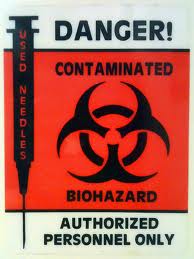
Biohazard.jpgAccording to a recent report by WBTV, a controversy has erupted over who is responsible for cleaning up hazardous waste left after an accident involving injuries.

After the injured had been treated at the scene and sent off to receive additional medical care, what was left behind at the scene was a slew of bloody gauze and soiled latex gloves used by EMS to stabilize and treat the injured passengers. The law currently does not provide any guidance about who is supposed to clean up the scene of an accident. Mark Fagala, a biohazard specialist, said, “EMS takes ’em in, Highway Patrol clears, and it’s just left for the property owner to clean up.”

The homeowner with bloody gauze strewn around his yard was not satisfied with being responsible for having to clean up a mess for which he was not responsible. He called the City of Charlotte and complained. Someone was immediately sent out to properly dispose of the hazardous waste. There are guidelines for proper disposal of biological waste and the fact that there are not clear provisions regarding the clean-up after an accident means that someone has dropped the ball.

Only two states in the country have specific rules for disposal of biological waste, Florida and California. North Carolina has no such laws and Fagala thinks that it is time for that to change. The risk of infection and injury is high in this situation. The owners of the property where an accident has occurred has no way of knowing if any of the injured people carried life threatening diseases and whether they are putting their own health at risk if they attempt to dispose of the material.

The best and most efficient thing to do is to lobby lawmakers to draft a bill addressing this issue. There are several possibilities. EMS could be required to come back and clean the scene. EMS could be required to notify an accident and crime scene clean-up agency prior to leaving the scene. The police department could also be required to do the same. Whatever the avenue taken by lawmakers, it will be better than leaving an innocent property owner with the responsibility of clearing their property of hazardous material.

Continue Reading

Wheelchair.jpgAccording to an article by the Charlotte Observer, on May 23, 2010, Rachelle Chapman walked to her bachelorette pool party and left paralyzed from the chest down. It was a normal day for her, but it ended with a life-changing event. Chapman and her friends were horsing around when one of her friends pushed her into the pool. She landed in an awkward position in the shallow end and injured her vertebra. Chapman immediately felt nothing from her chest down and had no feeling on the outside of her arms. Chapman and her fiancé were supposed to be married just weeks after the accident, but for obvious reasons, the wedding was postponed for more than a year.

Chapman has never revealed the name of the friend who pushed her into the pool. The woman was also a bridesmaid at Chapman’s wedding and she does not hold her friend responsible for her injuries. It was an unfortunate accident that led to tragic consequences.

As part of her recovery, Chapman trained at Project Walk, a facility that treats spinal cord injuries in California. During her stay there, she was able to gain a tremendous amount of strength. When she first got to Project Walk, she was weak and suffering from bone loss. At the end of her treatment she had increased her strength and was able to sit upright without passing out from low blood pressure.

Chapman was only at Project Walk for three weeks, but she hopes to go back again this year. She is now working out at home to continue her progress. Her fiancée and father-in-law built her a table to work out with while she is at home. She uses a home gym and does weight-bearing exercises to continue to build her strength. She has confidence that she will eventually be able to walk again and her nurses at Project Walk feel just as confident. Kimberly Davis, one Chapman’s instructors at Project Walk, says that it is possible that Chapman will be able to walk again. Davis concedes that this kind of spinal injury is unpredictable, but that unpredictability works in Chapman’s favor.

Continue Reading

jordan.jpgThe scene was akin to Black Friday chaos when Michael Jordan re-released his Air Jordan XI Concord sneakers. Shoppers lined up in droves to purchase the shoes and the police were called to several locations to keep the crowd in check. The Charlotte Observer reported that police were called to three malls in North Carolina to quell the riotous masses.

People began arriving at the stores early in the morning on Friday, December 23. The stores were allowed to sell the shoes starting at 5:00 AM, but several customers were lining up hours ahead of time. “There were people crying, screaming. People were running around, pushing. … Unbelievable. A lot of cursing,” said Numar Betris who was fortunate enough to purchase a pair at SouthPark Mall.

At Carolina Place Mall, shoppers reported that the crowd began getting extremely aggressive. There were three stores in the mall that were selling the shoes and the eager shoppers went charging through the store like bulls when the doors were finally opened. At least one person lost her shoe in the mêlée. The malls weren’t the only places slammed with crowds. Police were called to several shoe stores around North Carolina where shoppers reported being pushed and shoved attempting to buy the new Jordans.

If anyone suffered injuries from the chaos in the lines, those injuries could be the foundation for a personal injury lawsuit. One potential problem is that the plaintiff filing the suit may have a difficult time proving causation. The theory of liability would be negligence, but the plaintiff would have a hard time pinpointing which one of the hundreds of shoppers caused the plaintiff’s injuries.

Continue Reading

needle.pngWFMY News reports that a Greensboro woman has been charged with performing medical procedures without a proper medical license. Police say that Lauretta Cheek became the subject of an investigation when one of her “patients” filed a complaint against her. The “patient” claimed that a friend took her to see Cheek so that she could receive enhancement injections in her buttocks. After the procedure, she began to have severe complications and visited the emergency room in Charlotte, North Carolina on two separate occasions.

The patient filed a complaint with the health department and that is when the police launched their investigation into Cheek’s practices. The patient told investigators that she found out about Cheek’s cheap butt injections through the grapevine at her job as an exotic dancer. Apparently these enhancements were important for her career, but not important enough that she would go through the proper procedures to procure them. Police say that the procedure took place inside a hotel room and cost the patient a total of $500.00.

Cheek faces criminal penalties for her actions. She has been charged with a misdemeanor count of Practicing Medicine without a license. This, however, is not Cheek’s first rodeo. Back in 2008, she was charged with one count of Practicing Medicine without a license and one count of Obtaining a Controlled Substance by Fraud/Forgery. At the time of the new misdemeanor charge filed against her, she was still on probation for the 2008 charges. It is likely that these new charges amount to a violation of her probation, so it possible that Cheek may be serving out the remainder of her sentence inside a cell.

In addition to these criminal charges, Cheek faces potential civil liability from this patient and any other person who received her injections and suffered injury. However, there’s a problem. North Carolina is one of the few states that follow the doctrine of pure contributory negligence. Pure contributory negligence prevents the plaintiff from recovering from the defendant in a negligence action if the plaintiff is even 1% at fault for his or her injuries.

North Carolina is also unique in that its contributory negligence law is statutory. Thus, the patient is going to have a difficult time establishing that she was not negligent in attempting to receive a bargain butt injection in the back room of a cheap hotel. It is likely that a jury would find that she was equally at fault for her injuries. Further, given North Carolina’s pure contributory negligence position, even if the jury found that her failure to exercise reasonable care for her own safety amounted to only 1% fault, she would still be barred from recovery.

Continue Reading

According to ESPN, NASCAR Team Owner Rick Hendrick broke his ribs and his shoulder following a crash aboard his private plane. The injury occurred despite his doing everything he could think to prevent the injury, including wearing his seatbelt. Hendrick and his wife were aboard their Gulfstream 150 when it landed at Key West Airport. The plane experienced some braking problems and ran off of the runway. “My belt was on, and something came loose in the seat itself,” Hendrick said. “I hit the bulkhead and my wife. My chest and head went into the seat in front of me, and that’s where I (broke) my ribs and I had a concussion.” After the accident, Hendrick and his wife were hospitalized, but neither pilot was injured.

Hendrick is the owner of Hendrick Motorsports organization which provides equipment and technical support for Stewart-Haas Racing. Hendrick and star racer Jimmie Johnson co-owned the plane, which was used primarily for Johnson’s family’s travels to and from races. This is not the first time that a plane owned by Hendrick was involved in a crash. In 2004, another one of Hendrick’s planes crashed, killing 10, including Hendrick’s son, brother, and nieces.

It is unlikely that anyone is at fault for Hendrick’s injuries. Regular maintenance would be the only real way to catch such problems before they happen. Following instructions from the flight crew and wearing safety restraints are also critical but here nothing would’ve helped given that the seat itself was the cause of the problems. While there does not appear to have been any negligence on the part of the plane’s owners or flight crew, had anyone else on the plane been injured the owners would’ve potentially been in hot water over the thoroughness of their maintenance. To minimize such potential liability plane owners should hire a well respeted company to regularly inspect their aircraft. As powerful members of the NASCAR community, containing risk is very important and compliance with federal aviation safety regulations is paramount.

Continue Reading

Contact Information